Sonari - Sound as medicine

Design Brief
This project explored the role of sound as a design medium, investigating its potential to influence cognitive performance and emotional states. Positioned within the context of growing mental health challenges and increasing cognitive demands, the project sought to identify non-invasive, accessible approaches to supporting wellbeing through auditory experience.
Focusing on students as a key user group, the project addressed everyday challenges such as stress, procrastination, and difficulty maintaining focus during periods of work and study. These issues often disrupted productivity and negatively impacted overall quality of life, highlighting a clear opportunity for design intervention.
Through research and experimentation, the project aimed to uncover how sound could be intentionally designed to promote concentration, regulate mood, and support more positive and productive mental states. The outcome translated these insights into a considered design response that enhanced the study experience through sound.
Context
In essence, this project was a wearable sound device designed to tackle the specific issues of cognition and emotion. But it also turned into a new listening experience as well as a fashion piece.
Development

This project taught me a wide range of new skills, particularly in the area of textile design and fabrication. One of the most valuable aspects of the experience was learning how to work with textiles, as I initially had little to no experience with sewing or fabric construction techniques.
Through experimentation, iteration, and consistent practice, I was able to develop the skills required to produce multiple textile prototypes and gain confidence working with unfamiliar materials and processes. The project highlighted the importance of hands-on learning and adaptability within the design process, especially when stepping outside of my existing skill set.
As the project progressed, I developed a stronger understanding of how textiles behave, how different construction methods influence form and function, and how prototyping can be used to refine both aesthetic and practical outcomes. Overall, the experience expanded my technical abilities and reinforced the value of learning through making and experimentation.
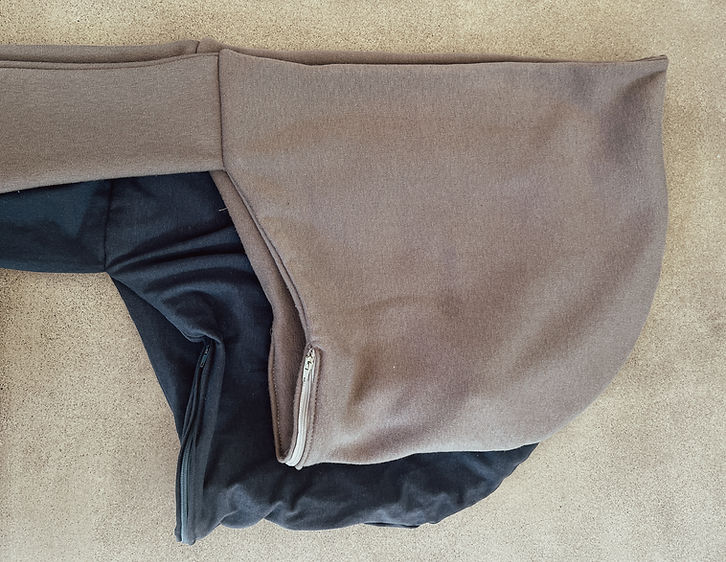
These images show some of the development phase, from cutting the fabrics to sewing different prototypes.

The design evolved through many different forms throughout the development process. As the project progressed, I realised the concept had significant potential and could be applied across a wide range of use cases and technological directions. This led to an iterative design approach focused on exploring multiple possibilities before refining the final outcome.
I experimented with a variety of form factors to better understand how the product could function physically and interact with users in different contexts. Alongside this, I conducted user testing to evaluate the strengths and weaknesses of each iteration, helping identify key considerations relating to usability, comfort, practicality, and overall user experience.
The process reinforced the importance of prototyping and feedback within design development, demonstrating how testing and iteration can reveal opportunities that may not have been initially apparent. Overall, the project strengthened my ability to critically evaluate design decisions and adapt concepts based on both user insight and functional requirements.


This stage of the project showcases the development of the technology and electronic prototyping integrated within the design. The electronic prototyping skills I developed while working on the synthesiser project proved highly valuable here, allowing me to approach the technical aspects of the design with greater confidence and understanding.
One of the main challenges was determining how to effectively house the required technology within the hood while ensuring the components remained both accessible and modular. This required careful consideration of spatial layout, assembly, usability, and maintenance, alongside balancing the functional requirements with the overall form and aesthetic of the design.
Through this process, I gained further experience in integrating electronics within a physical product and developed a stronger understanding of modular design principles. The project reinforced the importance of designing technology systems that are not only functional but also adaptable, maintainable, and user-friendly.

Outcome
The outcome of this project represented a full year of honours development focused on creating a product and experience that I am genuinely proud of. The project resulted in the design of a new sound-based experience and accompanying device that explores unique sensory and emotional interactions, many of which are difficult to fully communicate without experiencing the product in person.
Throughout the year, the project pushed me to develop a wide range of new skills across multiple disciplines. I learned how to sew and work with textiles, expanded my technological and electronic prototyping abilities, and significantly strengthened my overall design iteration process through continuous testing, refinement, and experimentation.


